
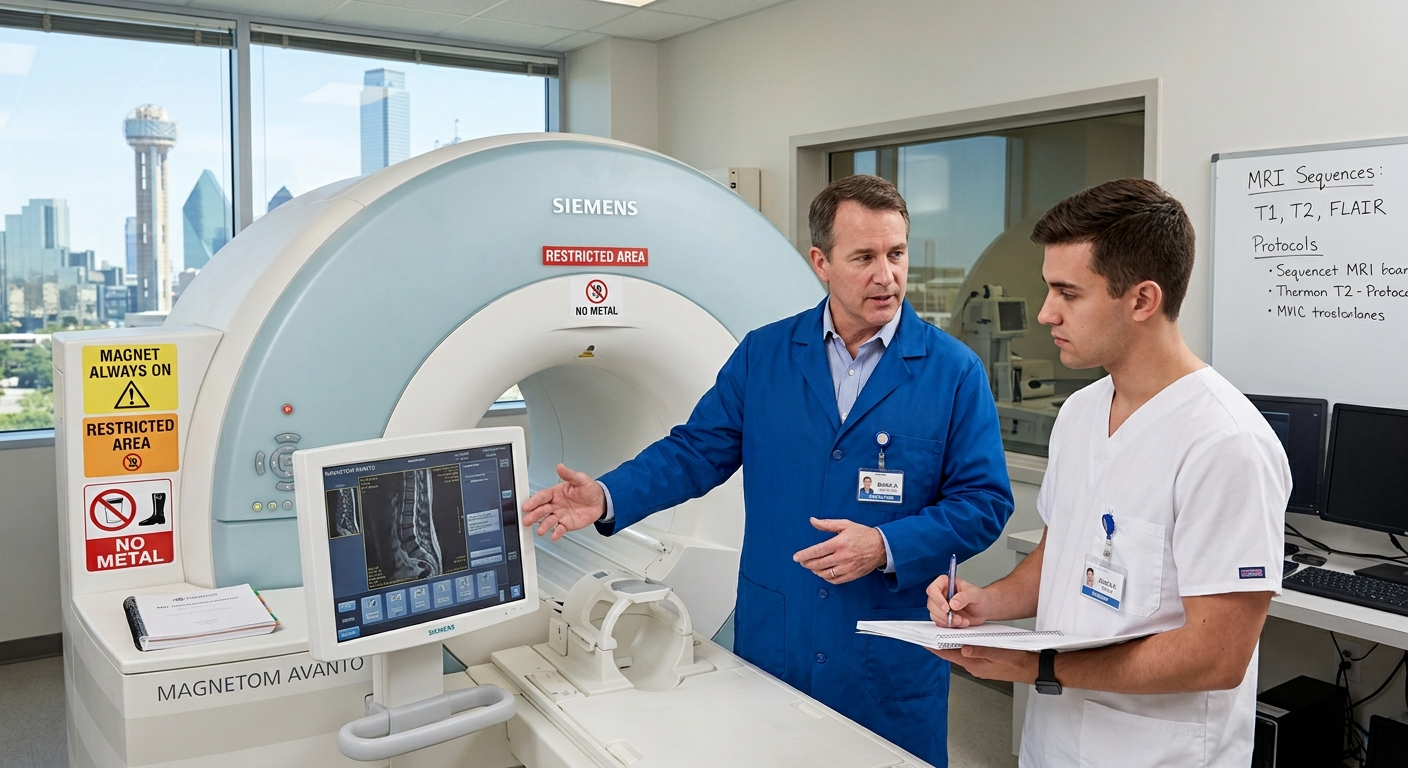
Becoming an MRI Technologist in Dallas: A Complete Career and Training Guide
If you're searching for a way into one of healthcare's most in-demand imaging careers, top MRI training in Dallas, TX is one of the most practical entry points into the field of magnetic resonance imaging. Dallas has grown into a major hub for diagnostic imaging careers, driven by its expanding hospital networks, outpatient imaging centers, and orthopedic and oncology practices that depend on skilled MRI technologists every day. This guide walks through what MRI training actually involves, what to expect from a program in the Dallas-Fort Worth area, certification requirements, career outlook, and how to choose the right training path for your goals.
What Is MRI Training and Why It Matters
MRI training prepares students to operate magnetic resonance imaging equipment — machines that use powerful magnets and radio waves, rather than ionizing radiation, to produce detailed cross-sectional images of the body's soft tissue, organs, joints, and nervous system. Unlike general radiologic technology, which covers X-ray and CT alongside other modalities, MRI training focuses specifically on the physics of magnetic resonance, patient positioning for MRI scans, contrast administration protocols, and strict MRI safety procedures required around high-powered magnetic fields.
A quality MRI program doesn't just teach you to push buttons on a scanner. It builds competency in:
- MRI physics and instrumentation
- Cross-sectional anatomy as it appears on MR images
- Patient screening and MRI safety (including ferromagnetic screening)
- Scan protocols for brain, spine, musculoskeletal, abdominal, and cardiac imaging
- Contrast media administration
- Image quality assessment and artifact correction
- Clinical patient care and communication
This combination of classroom instruction and hands-on clinical practice is what separates a credentialing-ready MRI technologist from someone who has only learned the equipment in theory.
Who Should Pursue MRI Training in Dallas
MRI training in Dallas, TX typically attracts a few distinct groups of students:
Career changers looking to move into healthcare without committing to a four-year nursing or medical degree. MRI technology offers a faster, more direct path into a clinical, patient-facing healthcare role.
Current radiologic technologists (X-ray techs) who already hold ARRT certification in radiography and want to add an MRI credential to increase their earning potential and job flexibility. This is one of the most common and efficient routes, since many MRI programs for registered techs are shorter and more advanced than entry-level tracks.
Allied health students coming from related fields such as respiratory therapy, nuclear medicine, or sonography who want to diversify their imaging skill set.
Recent high school or college graduates interested in a technical healthcare career that doesn't require years of graduate-level education but still offers strong salary potential and job security.
Because Dallas has such a dense concentration of hospitals, imaging centers, and specialty clinics, the local job market tends to reward technologists who are cross-trained or who come out of their program already clinically competent, not just classroom-trained.
Program Structure: What Dallas MRI Training Typically Covers
Most MRI training programs in the Dallas-Fort Worth metro area are structured in two phases: didactic coursework and a supervised clinical externship.
Didactic (Classroom) Phase
This portion typically includes:
- Principles of magnetic resonance physics
- MRI instrumentation and equipment operation
- Sectional anatomy and pathology recognition
- Patient care, ethics, and HIPAA compliance
- MRI safety standards, including guidelines established by the American College of Radiology (ACR)
- Pharmacology related to contrast agents
Clinical Externship Phase
Hands-on training is arguably the most important part of any MRI program, and it's where Dallas's healthcare infrastructure becomes a real advantage. Clinical placement sites can include hospital imaging departments, outpatient diagnostic centers, and orthopedic or neurological imaging practices throughout the Dallas-Fort Worth area. During this phase, students perform supervised scans, learn real-world patient positioning, troubleshoot image quality issues, and build the repetitions needed to scan efficiently and safely once credentialed.
Programs vary in length — some accelerated MRI certificate programs for already-licensed radiologic technologists can be completed in a matter of months, while more comprehensive entry-level programs may run closer to a year when clinical hours are included.
Certification Requirements: ARRT and Beyond
For most employers in Texas, ARRT (American Registry of Radiologic Technologists) certification in MRI is the credential that matters most. To sit for the ARRT MRI certification exam, candidates generally need to meet one of two pathways:
- Primary Pathway — Completing an accredited educational program that includes both classroom instruction and documented clinical competencies in MRI.
- Post-Primary Pathway — Already holding ARRT certification in another discipline (such as Radiography, Nuclear Medicine, or Radiation Therapy) and completing MRI-specific clinical experience requirements along with structured education hours.
A quality Dallas-based MRI training program should be structured around ARRT exam eligibility from day one, since graduating from a program that doesn't align with ARRT's clinical competency requirements can leave you with a certificate but no pathway to actual registration — a critical detail many students overlook when comparing schools.
In addition to ARRT certification, Texas does not currently require a separate state license specifically for MRI technologists the way it does for general radiologic technologists through the Texas Medical Board, but employers almost universally require ARRT(MR) certification or active progress toward it, along with CPR/BLS certification.
Why Dallas Is a Strong Market for MRI Technologists
Dallas-Fort Worth is one of the fastest-growing metro areas in the country, and its healthcare sector has expanded right alongside it. Several factors make Dallas particularly favorable for someone completing MRI training:
- High hospital density — Major health systems and specialty hospitals throughout Dallas, Plano, Irving, Fort Worth, and surrounding suburbs regularly staff outpatient and inpatient MRI departments.
- Growth in outpatient imaging centers — As healthcare shifts toward outpatient diagnostics, freestanding imaging centers have multiplied across the metroplex, creating steady demand for MRI technologists outside of traditional hospital shifts.
- Orthopedic and sports medicine demand — Dallas's sports medicine and orthopedic specialty clinics rely heavily on musculoskeletal MRI, a subspecialty that trained technologists can use to differentiate themselves.
- Population growth — As the DFW population continues to climb, so does demand for diagnostic services tied to aging populations, chronic disease management, and preventive care.
This combination of healthcare infrastructure and population growth means that MRI technologists trained locally are often able to move directly from clinical externship sites into job offers, especially when they've built relationships with supervising technologists and radiologists during training.
MRI Technologist Salary and Career Outlook
Compensation for MRI technologists in Texas tends to be competitive with — and often higher than — general radiologic technologist pay, largely because of the additional specialization required. While exact figures vary by employer, experience, and shift differential (night and weekend MRI shifts often pay more), MRI technology consistently ranks among the higher-paying allied health careers that don't require a bachelor's degree.
Career advancement opportunities for MRI technologists include:
- Lead or chief MRI technologist roles
- MRI applications specialist positions with equipment manufacturers
- Cross-training into CT or interventional radiology
- Clinical instructor or program faculty roles
- MRI safety officer positions within hospital systems
Because MRI technology is a licensed, credentialed specialty rather than an entry-level job, it tends to offer more career stability and upward mobility than many other technical healthcare roles.
How to Choose the Right MRI Training Program in Dallas
Not all MRI training programs are created equal, and choosing the wrong one can cost you time, money, and ARRT eligibility. When evaluating programs in the Dallas area, consider the following:
Accreditation status. Confirm the program is recognized in a way that satisfies ARRT's education requirements, whether through JRCERT accreditation or an approved post-primary structure for already-certified technologists.
Clinical site partnerships. Ask specifically which hospitals, imaging centers, or clinics the program partners with for externships. Strong clinical partnerships in the Dallas-Fort Worth area translate directly into stronger job placement outcomes.
Program length and schedule flexibility. Many students pursuing MRI training are working adults or already-certified radiologic technologists. Look for programs offering evening, weekend, or hybrid scheduling if you need to continue working while you train.
Instructor credentials. Programs led by ARRT-certified, clinically experienced MRI technologists tend to provide more relevant, up-to-date instruction than programs taught primarily from textbooks.
Job placement support. Ask whether the program offers resume support, interview preparation, or direct connections to hiring managers at partner clinical sites.
Exam pass rates. A program's ARRT exam pass rate is one of the clearest indicators of how well it prepares students for certification.
What a Typical Day Looks Like as an MRI Technologist
Understanding the day-to-day realities of the job can help you decide if MRI training is the right investment. A typical shift includes:
- Reviewing scheduled patients and their referring physician orders
- Screening patients for MRI safety contraindications (implants, pacemakers, metal fragments)
- Positioning patients and selecting appropriate imaging protocols
- Operating the MRI console to acquire diagnostic-quality images
- Administering contrast media when ordered, under appropriate supervision
- Reviewing images for quality and communicating with radiologists
- Documenting procedures and maintaining patient records
The role requires a mix of technical precision, physics knowledge, and genuine patient care skills, since many patients experience anxiety related to the enclosed scanner environment and the length of MRI exams.
Frequently Asked Questions About MRI Training in Dallas
How long does MRI training take?
Timelines vary significantly depending on your starting point. Already-certified radiologic technologists pursuing a post-primary MRI pathway may complete training in several months, while entry-level students without a prior imaging credential should expect a longer timeline that includes foundational coursework plus clinical hours.
Do I need to already be an X-ray technologist?
Not necessarily, but many of the fastest, most cost-effective MRI training pathways are designed for technologists who already hold ARRT certification in another modality. Entry-level MRI-only programs exist but are less common and should be vetted carefully for ARRT eligibility.
Is MRI training physically demanding?
The role involves patient transfers, positioning, and extended periods of standing or walking, so reasonable physical fitness is expected, though it's generally less physically demanding than many other clinical roles.
Can I work while completing MRI training?
Many programs in the Dallas area are structured with working professionals in mind, offering flexible scheduling so students can continue employment while completing coursework and clinical hours.
Conclusion
MRI training in Dallas, TX offers a direct, achievable pathway into one of healthcare's most stable and well-compensated technical careers. Whether you're an aspiring healthcare professional starting from scratch or an already-certified radiologic technologist looking to specialize, the combination of strong clinical infrastructure, growing demand for diagnostic imaging, and a clear ARRT certification pathway makes Dallas one of the better markets in Texas to pursue this career. The key to success isn't just completing a program — it's choosing one with accredited standing, strong clinical site partnerships, and a track record of preparing students who actually pass the ARRT MRI exam and get hired. If you're ready to move forward, the next step is reaching out to a local, accredited MRI training program to confirm eligibility requirements and discuss available start dates.