
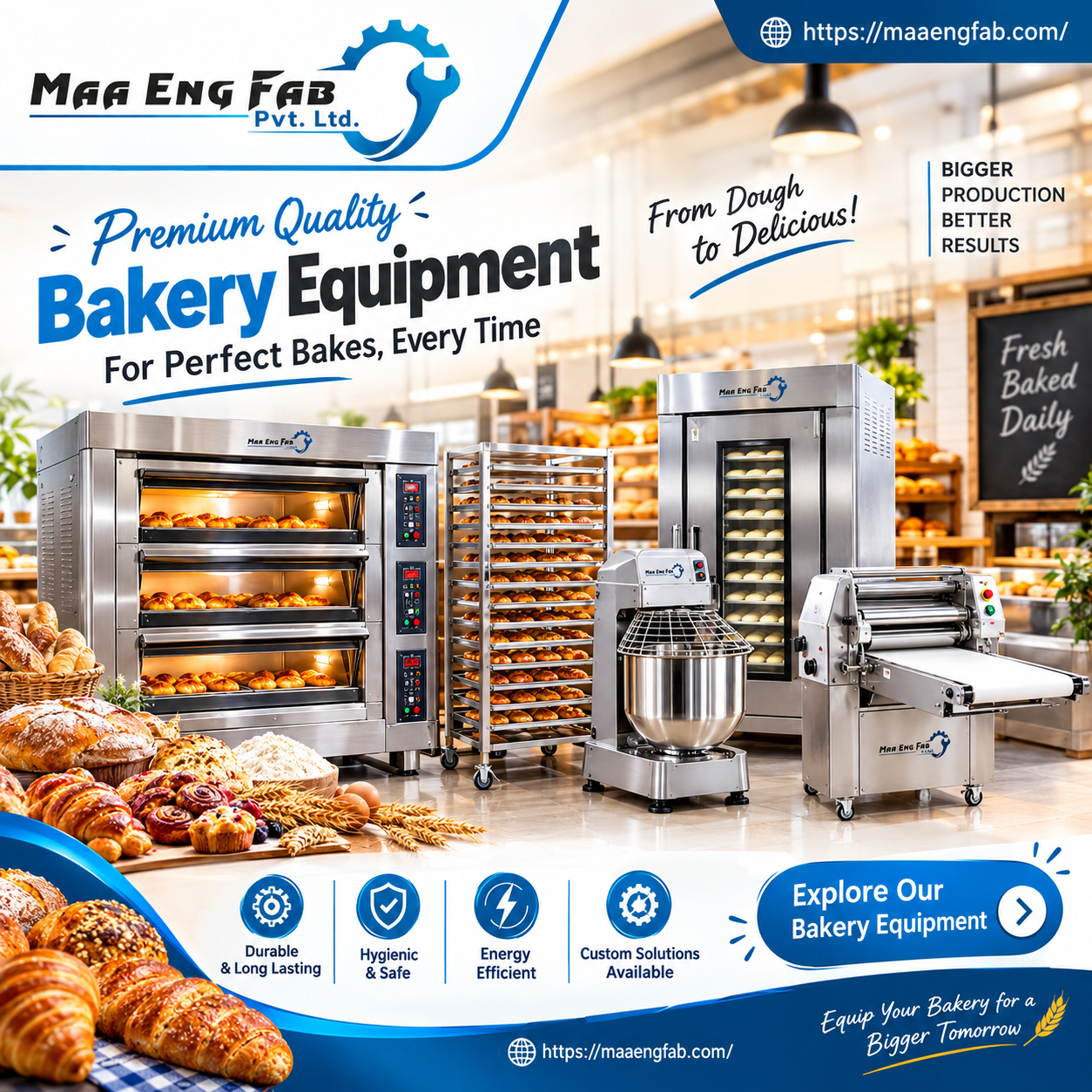
How Bakery Equipment Manufacturer in India Can Prevent Cross-Contamination Through Hygienic Equipment Design, Allergen Changeover Validation and Cleanability Testing
Introduction
In modern bakery manufacturing, equipment performance is not measured only by production capacity, operating speed or finished-product quality. Hygiene, allergen management and effective cleaning are equally important when machinery is used to process different products on the same production line.
Commercial bakeries may manufacture bread, biscuits, cookies, cakes, muffins, rusks and filled bakery products in the same facility. These products can contain different ingredients, including wheat, milk, eggs, soy, peanuts, tree nuts and sesame. If residues from one product remain on equipment and transfer into another product, the bakery may face food-safety risks, product rejection, costly recalls and damage to customer trust.
For a Bakery Equipment Manufacturer in India, preventing cross-contamination begins during equipment design. Conveyor joints, product-contact surfaces, seals, scrapers, hoppers, nozzles, dust extraction points and difficult-to-access machine areas must be evaluated for their ability to be cleaned effectively.
The equipment must also suit the bakery's actual sanitation programme. A machine designed for dry cleaning may require different construction and maintenance practices from equipment intended for wet cleaning. Similarly, equipment handling sticky dough or cream filling presents different cleaning challenges from machinery processing dry biscuits.
This guide explains how hygienic equipment design, allergen changeover procedures, cleanability testing and preventive maintenance can help bakeries control contamination risks. It also provides practical evaluation criteria for buyers selecting industrial bakery machinery.
1. Understanding Cross-Contamination in Bakery Production
Cross-contamination occurs when an unwanted biological, chemical or physical hazard is transferred from one material, product, surface or environment to another.
In bakery facilities, contamination risks may arise during ingredient handling, mixing, dividing, moulding, depositing, baking, cooling, conveying, slicing and packaging.
Common examples include:
-
Residual dough transferring between production batches.
-
Milk-containing filling remaining inside a depositor after a product changeover.
-
Nut particles remaining around a conveyor guide or cutting mechanism.
-
Flour dust moving from one processing area into another.
-
Cleaning chemical residues remaining on inadequately rinsed equipment.
-
Fragments from worn seals, damaged belts or deteriorating components entering the product stream.
Not all contamination hazards are controlled in the same way. Microbial hazards, allergen cross-contact, chemical residues and physical contamination require appropriate, hazard-specific controls.
A bakery should identify which risks are relevant to each machine and product. Equipment selection should then support the facility's documented food-safety and sanitation procedures.
Why equipment design matters
Even a well-trained operator can struggle to clean a machine if product residues accumulate behind inaccessible panels, inside hollow components or around poorly designed joints.
Hygienic design helps make cleaning practical and repeatable. It does not replace sanitation procedures, operator training or verification, but it reduces the opportunities for residues to remain unnoticed.
2. Why Allergen Control Is Important in Bakery Machinery
Allergens require particular attention because small amounts of an allergenic ingredient can create a risk for susceptible consumers.
Depending on the products manufactured, bakery facilities may handle ingredients such as milk, eggs, soy, peanuts, tree nuts, sesame and cereals containing gluten. The applicable allergen declaration requirements depend on the destination market and its regulations.
A bakery producing plain biscuits and nut-containing cookies on the same equipment must evaluate whether residues can transfer between production runs.
Potential transfer points include:
-
Mixing bowls and dough-contact paddles.
-
Ingredient hoppers and feeding systems.
-
Depositing nozzles and filling pipes.
-
Cutting blades and moulding components.
-
Conveyor belts, scrapers and side guides.
-
Cooling conveyors and product-contact rollers.
-
Packaging equipment that handles exposed products.
The risk depends on the allergen, its physical form, the equipment configuration, the cleaning method and the next product being manufactured.
A Bakery Equipment Manufacturer in India should therefore understand the intended product range and changeover requirements before recommending machinery. Equipment that is suitable for a single-product line may require additional design features when frequent allergen changeovers are expected.
3. Identifying Hidden Residue Accumulation Points
One of the most common challenges in bakery sanitation is the presence of locations that are difficult to inspect or clean.
These locations may not be obvious during routine production. Residues can accumulate gradually and become a contamination source during a later production run.
Conveyor joints and belt connections
Conveyor systems may contain joints, belt edges, rollers, scrapers and transfer plates where crumbs, dough or filling can collect.
Inspect whether the belt design allows appropriate access to product-contact areas. Check whether the belt can be removed or lifted safely where the sanitation procedure requires it.
Hopper corners and feeding mechanisms
Dough and batter can adhere to hopper walls, outlet transitions and feeding mechanisms. Sticky or high-fat formulations may create particularly challenging residues.
Hopper geometry should support product flow while allowing the relevant surfaces to be inspected and cleaned.
Seals, gaskets and joints
Damaged or poorly fitted seals can create narrow gaps where food material accumulates. Repeated dismantling and reassembly may also introduce problems if components are incorrectly installed.
Seals should be suitable for the food-contact application, operating temperature and approved cleaning chemicals.
Hollow structures and enclosed areas
Poorly sealed hollow members or inaccessible enclosed spaces can create hygiene concerns if product or moisture enters them and cannot be removed.
Equipment should be evaluated for unnecessary crevices, exposed threads in product zones and construction features that make inspection difficult.
Scrapers, blades and removable tooling
Scrapers and blades can collect residues around mounting points or beneath protective covers. Removable tooling should be designed for safe removal, cleaning, inspection and correct reinstallation.
A practical equipment inspection should identify these locations before production begins, rather than waiting for a contamination incident to reveal them.
4. Hygienic Design Principles for Bakery Equipment
Hygienic design aims to minimise contamination risks and make equipment easier to clean, inspect and maintain.
The appropriate design depends on the machine, product, sanitation method and risk assessment.
Suitable food-contact materials
Materials used in product-contact areas should be suitable for the intended food, temperature range and cleaning conditions.
Stainless steel is commonly used in bakery equipment because suitable grades can provide corrosion resistance, durability and cleanable surfaces. However, the correct material grade and surface finish depend on the application.
Plastic belts, elastomers and other non-metallic components must also be appropriate for their intended use.
Buyers should request material specifications and relevant food-contact compliance documentation rather than relying only on a general statement that the equipment is food-grade.
Smooth, cleanable surfaces
Rough, damaged or poorly finished surfaces can retain food residues and complicate cleaning.
Welds, joints and transitions in product-contact areas should be assessed for smoothness, accessibility and cleanability. Surface requirements should reflect the product and sanitation method.
A visually polished surface is not automatically hygienic if the surrounding geometry creates inaccessible gaps.
Avoiding unnecessary crevices
Overlapping plates, exposed threads, poorly fitted covers and inaccessible recesses can trap food particles.
Equipment designers should minimise such features in product zones and provide practical access where dismantling is necessary.
Drainage and moisture control
For equipment that undergoes wet cleaning, surfaces and structures should support appropriate drainage and prevent unwanted pooling.
However, wet cleaning is not suitable for every bakery process. Dry ingredients and flour-handling systems may require controlled dry-cleaning methods to prevent moisture-related problems.
The design must match the intended sanitation procedure.
5. Flour Dust and Airborne Particle Management
Flour dust is a major consideration in bakery facilities because it can spread beyond the point where ingredients are handled.
Dust can settle on machinery, control panels, conveyors, product surfaces and nearby equipment. Movement of personnel, compressed air, poorly directed extraction and uncontrolled ingredient transfer can redistribute particles.
In addition to contamination concerns, airborne flour dust can create occupational health and combustible-dust hazards. These require appropriate risk assessment and engineered controls.
Practical equipment considerations
A bakery should evaluate:
-
Enclosed flour-transfer arrangements where appropriate.
-
Local dust extraction at ingredient charging points.
-
Suitable seals around transfer connections.
-
Accessible surfaces for cleaning.
-
Separation between dusty operations and exposed finished-product zones.
-
Appropriate dust collection and disposal procedures.
Compressed air should not be used indiscriminately to clean flour from machinery because it can disperse dust into the surrounding environment.
Dust collection systems must be designed, installed and maintained according to the facility's risk assessment and applicable safety requirements. Combustible-dust controls may require specialist engineering review.
A manufacturer should explain how the proposed equipment interfaces with the bakery's dust management arrangements rather than treating extraction as an unrelated facility issue.
6. Selecting the Correct Cleaning Method: Dry, Wet or Controlled Cleaning
The most appropriate cleaning method depends on the product residue, equipment design, food-safety risks and the bakery's sanitation programme.
There is no single cleaning method that is ideal for every bakery machine.
Dry cleaning
Dry cleaning may be appropriate for certain dry-product operations where moisture would create additional problems.
Methods may include suitable vacuum systems, brushes or controlled removal of loose material. The tools and procedures should be appropriate for the hazard being controlled.
Dry cleaning must not be assumed to remove allergen residues adequately in every situation. Its effectiveness needs to be established for the equipment and product involved.
Wet cleaning
Wet cleaning may be suitable for equipment that handles sticky dough, cream, fillings or other residues that cannot be effectively removed by dry methods.
The procedure may involve detergent application, mechanical action, rinsing and drying, depending on the approved sanitation programme.
Equipment intended for wet cleaning should have appropriate material compatibility, access and drainage features. Electrical components and bearings must be protected according to the equipment design and cleaning instructions.
Controlled cleaning and dismantling
Some machines require partial dismantling to access product-contact components.
This may apply to depositors, filling systems, cutters, moulding mechanisms and other equipment with internal product pathways.
Dismantling procedures should specify which parts must be removed, how they are cleaned and inspected, and how they are reassembled.
The correct procedure should be documented and demonstrated during operator training.
7. Allergen Changeover: From One Product to Another
A product changeover is a critical control point when the next product has a different allergen profile.
For example, a bakery may switch from a plain cookie to a product containing milk chocolate or nuts. The changeover procedure must address residues left in equipment and the risk of transfer to the next batch.
A robust changeover programme generally includes the following steps.
Step 1: Identify the product transition
Confirm the outgoing and incoming products, their ingredient lists and the allergens present in each formulation.
Step 2: Identify relevant equipment
Determine which machines and surfaces contacted the allergenic ingredient. Include connected conveyors, transfer components, hoppers and downstream handling equipment.
Step 3: Apply the approved cleaning procedure
Use the documented method for the specific equipment and residue. Follow the prescribed dismantling, cleaning, rinsing and drying instructions where applicable.
Step 4: Inspect the equipment
Check relevant surfaces, joints, tools and product pathways for visible residues and signs of incomplete cleaning.
Step 5: Verify cleaning effectiveness
Use the verification methods defined in the sanitation programme. Depending on the risk, these may include visual inspection, suitable swab methods or allergen-specific testing.
Step 6: Authorise production restart
Production should resume only after the applicable release criteria are met and required records are completed.
The exact procedure depends on the hazard assessment and product requirements. A generic checklist should not replace a validated sanitation programme.
8. Cleaning Validation Versus Cleaning Verification
These terms are related but have different purposes.
Cleaning validation
Validation provides documented evidence that a specified cleaning procedure can consistently achieve the required outcome under defined conditions.
For example, a bakery may evaluate whether a particular cleaning procedure removes relevant allergen residues from a depositor when switching between two formulations.
Validation should consider the equipment configuration, residue characteristics, cleaning agents, contact conditions, sampling locations and acceptance criteria.
Cleaning verification
Verification checks whether the established procedure has been carried out effectively during routine operations.
Examples may include reviewing cleaning records, conducting visual inspections and using appropriate test methods at defined points.
Why both are important
A procedure may appear effective on one occasion but fail under different conditions, such as a longer production run or a different formulation.
Validation establishes confidence in the method. Verification helps confirm that the method continues to work during daily production.
The bakery's food-safety team should determine the required approach based on its risk assessment, customer requirements and applicable regulations.
9. Choosing Suitable Allergen Testing Methods
Testing can support cleaning verification, but the method must be suitable for the specific allergen and application.
Visual inspection
Visual inspection is useful for identifying visible food residues, but it cannot reliably confirm the absence of allergenic proteins.
A surface may appear clean while still containing residues below the level visible to the eye.
Protein-residue tests
Certain tests detect general protein residues. They can provide useful information about cleaning performance, but a positive or negative result does not necessarily establish the presence or absence of a particular allergen.
Allergen-specific swab tests
Some tests are designed to detect specific allergenic materials. Their suitability depends on the allergen, surface, residue condition and test method.
Laboratory analysis
Where necessary, validated laboratory methods can support more detailed investigation. Sampling plans should reflect the equipment and potential contamination pathways.
No test should be interpreted without considering its detection limits, sampling method, possible interferences and intended use.
A bakery should not claim that equipment is completely allergen-free based solely on visual inspection or a single swab result.
10. Designing Conveyors for Effective Cleaning
Conveyor systems often connect multiple processing stages, so residues can transfer across different production zones if cleaning is inadequate.
A hygienic conveyor design should support both product handling and sanitation.
Important considerations include belt material, belt-edge construction, roller arrangement, scraper access, frame geometry and the ability to inspect relevant surfaces.
Belt selection
The belt must suit the product, operating temperature, mechanical loads and approved cleaning method.
A belt used near an oven may require different temperature resistance from one used for cooled finished products.
Belt tracking and tension
Incorrect tracking can cause belt-edge wear or contact with the frame. Such damage may complicate cleaning and create a physical contamination concern.
Maintenance procedures should include inspection of belt alignment, tension and wear.
Transfer points
Transfer plates, rollers and conveyor gaps should be designed to minimise product loss and make relevant areas accessible for cleaning.
Cleaning access
If a conveyor must be lifted or partially dismantled for cleaning, the procedure should be safe, practical and repeatable.
The bakery should confirm that operators can access the required areas without bypassing guards or exposing themselves to moving machinery.
11. Hygienic Design for Depositors, Mixers and Filling Equipment
Different bakery machines present different contamination risks because of the materials they handle.
Mixers
Mixers can retain dough or batter around paddles, shafts, bowl edges, discharge points and attachments.
The design should provide suitable access for inspection and cleaning. Removable attachments should be easy to identify and reinstall correctly.
Depositors
Depositors may contain valves, pistons, seals, nozzles and internal pathways that contact batter, cream or fillings.
The sanitation procedure should specify how these components are cleaned and checked. Particular attention is required when sticky or high-fat products are processed.
Filling systems
Filling equipment may handle chocolate, jam, custard, cream or other materials with distinct cleaning requirements.
The system should be compatible with the filling's properties and the intended cleaning method. Dead spaces and poorly drained sections should be evaluated.
Cutting and moulding equipment
Cutters, moulds and forming tools may collect product residues around their edges and mounting points.
Where multiple formulations are used, changeover and cleaning procedures should account for the specific contact surfaces and possible residue transfer.
The equipment manufacturer should provide clear cleaning and maintenance instructions for the actual configuration supplied.
12. Cleaning Chemical Compatibility and Material Protection
Cleaning effectiveness depends partly on using appropriate chemicals under the correct conditions.
A detergent that works well for one type of residue may be less effective for another. For example, protein-rich residues, fats and sugary deposits may require different cleaning approaches.
However, stronger chemicals are not automatically better. Incorrect concentration, temperature or contact time can damage seals, belts, coatings and other components.
Before selecting a cleaning agent, the bakery should consider:
-
Residue type and amount.
-
Material compatibility.
-
Recommended chemical concentration.
-
Water temperature and contact time.
-
Rinsing requirements.
-
Equipment manufacturer's instructions.
-
Applicable chemical handling and food-safety requirements.
Cleaning chemicals should be stored, prepared and used according to their instructions and the site's safety procedures.
After wet cleaning, equipment should be returned to the required condition before production resumes. This may include appropriate rinsing, drying and inspection.
13. Maintenance Practices That Support Food Safety
Hygienic equipment design is not enough if components deteriorate or maintenance is neglected.
Damaged seals, cracked belts, corroded surfaces and loose fasteners may create locations where residues accumulate or physical contamination occurs.
Preventive maintenance should be based on manufacturer recommendations, operating hours, inspection findings and the production environment.
A maintenance programme may include:
-
Inspection of seals and gaskets.
-
Belt condition and tracking checks.
-
Inspection of product-contact surfaces.
-
Review of fasteners and mechanical connections.
-
Replacement of damaged or worn components.
-
Verification after repairs.
-
Documentation of maintenance activities.
Lubricants used around food-processing equipment should be selected according to the application and applicable requirements. Where incidental contact is possible, appropriate food-grade lubricants may be required.
Maintenance work should also include cleaning and inspection before the machine returns to production.
14. Separating Raw Ingredients from Exposed Finished Products
Contamination control extends beyond individual machines. The layout of the bakery and the movement of ingredients, personnel and products also matter.
Flour handling and ingredient charging may generate dust, while cooling and packaging areas often handle exposed finished products.
The facility should assess whether the layout, airflow, material routes and cleaning practices reduce the risk of contamination moving from one area to another.
Possible controls include:
-
Appropriate separation of dusty operations.
-
Controlled movement of ingredients and finished products.
-
Dedicated tools for designated areas where justified.
-
Defined cleaning responsibilities.
-
Suitable storage of removable machine components.
-
Controls for personnel movement and handling practices.
Equipment design should support this wider hygiene strategy. For example, enclosed transfer arrangements may help reduce ingredient spillage, while accessible machine surfaces can make routine cleaning easier.
The precise controls should follow the facility's food-safety risk assessment.
15. Preventing Cross-Contamination During Product Changeovers
Changeovers can fail when operators rely on memory or follow different procedures between shifts.
A documented changeover system helps standardise the process.
An effective procedure should identify the outgoing product, incoming product, relevant allergens, required equipment dismantling, cleaning method, inspection points and production-release criteria.
It should also specify how removed parts are stored to prevent recontamination.
Where several product variants are manufactured, a bakery may use a product-changeover matrix to identify which transitions require additional cleaning or verification.
Such a matrix should be based on ingredient information and risk assessment rather than assumptions that similar-looking products have identical allergen profiles.
Production scheduling may also help reduce unnecessary changeovers, but scheduling alone cannot replace the required cleaning and verification steps.
16. Factory Acceptance Testing for Hygienic Equipment
Factory Acceptance Testing (FAT) provides an opportunity to inspect and evaluate machinery before it is dispatched.
For equipment with important sanitation requirements, the FAT should include more than a mechanical run test.
Buyers may request checks covering:
Construction and surface inspection
Review product-contact materials, joints, welds, seals, fasteners and access points.
Dismantling and reassembly
Confirm that components requiring routine cleaning can be removed and reinstalled using the documented procedure.
Cleaning access
Check whether operators can reach the relevant areas safely and effectively.
Documentation
Review cleaning instructions, maintenance requirements, material specifications and recommended replacement components.
Product-specific assessment
Where practical, use representative product residues to assess the practicality of the proposed cleaning method.
Acceptance criteria
Agree on the inspection procedure and required evidence before the test.
A FAT can identify design and documentation issues early, but it does not automatically prove that the complete sanitation programme will be effective at the buyer's facility.
17. Site Acceptance Testing and Commissioning
Site Acceptance Testing (SAT) checks the equipment after installation and integration into the bakery's production environment.
This stage is important because the final arrangement may differ from the factory setup. Additional conveyors, site utilities, surrounding equipment and actual cleaning practices can influence accessibility and performance.
SAT should consider:
-
Installation and equipment alignment.
-
Integration with connected machinery.
-
Access for cleaning and inspection.
-
Safe removal of designated components.
-
Operator training.
-
Verification of cleaning procedures.
-
Required sanitation and maintenance records.
Where relevant, the bakery should confirm that the approved cleaning method works with the installed configuration and actual product residues.
Any design changes made during installation should be reviewed to determine whether they affect cleanability or require additional testing.
18. Common Mistakes When Selecting Bakery Equipment
Mistake 1: Evaluating only production capacity
A machine may achieve the required output but still be difficult to clean.
Better approach: Include cleanability, maintenance access and sanitation requirements in the purchase specification.
Mistake 2: Assuming stainless steel guarantees hygienic design
Suitable materials are important, but poor joints, inaccessible gaps and inadequate drainage can still create hygiene problems.
Better approach: Inspect construction details and evaluate the actual cleaning procedure.
Mistake 3: Relying only on visual inspection
Visible cleanliness does not confirm the absence of allergenic residues.
Better approach: Combine visual inspection with appropriate verification methods based on the hazard assessment.
Mistake 4: Using the same cleaning method for every product
Different formulations leave different residues and may require different cleaning approaches.
Better approach: Establish product- and equipment-specific sanitation procedures.
Mistake 5: Ignoring downstream equipment
A mixer may be cleaned correctly while residues remain on a connected conveyor, depositor or transfer component.
Better approach: Evaluate the entire product pathway, including connected machinery.
Mistake 6: Neglecting spare parts and maintenance
Worn seals, damaged belts and poorly maintained surfaces can compromise cleaning performance.
Better approach: Establish preventive maintenance schedules and replacement criteria before production starts.
Mistake 7: Failing to document cleaning effectiveness
Without records, it becomes difficult to identify recurring failures or demonstrate consistent implementation.
Better approach: Maintain cleaning logs, inspection results, verification records and corrective-action documentation.
19. How to Choose a Bakery Equipment Manufacturer in India
When selecting a manufacturer, buyers should evaluate technical suitability, hygienic design, cleaning requirements and support throughout the equipment's operating life.
Explain the intended product range
Provide details about doughs, batters, fillings, toppings and allergens handled on the line. Explain how frequently the equipment will change between formulations.
Review construction and cleanability
Ask how the design minimises residue accumulation and how the required product-contact surfaces can be inspected and cleaned.
Request documentation
Review operating instructions, sanitation procedures, material specifications, maintenance schedules and recommended spare parts.
Discuss testing before purchase
Ask whether the manufacturer can demonstrate the cleaning procedure and inspect relevant areas during FAT. Agree on measurable acceptance criteria for the actual application.
Assess installation and after-sales support
Confirm operator training, commissioning assistance, maintenance support and the availability of replacement components.
Consider the total cost of ownership
Purchase price is only one part of the cost. Cleaning labour, downtime, water and chemical consumption where applicable, replacement parts and maintenance can influence long-term operating expenses.
A capable Bakery Equipment Manufacturer in India should be able to explain the engineering decisions behind the proposed equipment and how those decisions support the bakery's production and sanitation requirements.
20. Practical Buyer Checklist Before Finalising an Order
Use this checklist when evaluating bakery machinery intended for products with different allergen profiles.
-
Identify the products and ingredients the machine will handle.
-
Document relevant allergens and contamination risks.
-
Define the required cleaning method.
-
Review product-contact materials and documentation.
-
Inspect joints, seals, welds and potential residue traps.
-
Confirm access to hoppers, nozzles, conveyors and other contact surfaces.
-
Check whether components need to be dismantled for cleaning.
-
Review compatibility with approved cleaning chemicals.
-
Establish inspection and cleaning procedures.
-
Define suitable cleaning verification methods.
-
Confirm maintenance and replacement requirements.
-
Include sanitation-related checks in FAT and SAT.
-
Train operators on cleaning, reassembly and release procedures.
-
Maintain documented cleaning and corrective-action records.
This checklist can be adapted to the specific equipment and facility risk assessment. It should not be treated as a substitute for applicable food-safety regulations or a validated sanitation programme.
21. Frequently Asked Questions
1. What is cross-contamination in bakery manufacturing?
Cross-contamination occurs when unwanted biological, chemical or physical hazards transfer from one material, product, surface or environment to another. In bakeries, it may involve allergen residues, flour dust, cleaning chemical residues or physical particles.
2. How can bakery equipment design reduce allergen cross-contact?
Design features that improve access, minimise residue traps and support effective cleaning can help reduce allergen cross-contact risks. Their effectiveness depends on the equipment, product, sanitation method and verification programme.
3. Is stainless steel enough to make bakery equipment hygienic?
No. Suitable material selection is important, but surface condition, joints, welds, seals, drainage and cleaning accessibility also matter. Hygienic performance must be assessed as a complete design and sanitation system.
4. What is the difference between cleaning validation and verification?
Validation establishes documented evidence that a specified cleaning procedure can achieve the required result under defined conditions. Verification checks whether the procedure continues to be performed effectively during routine production.
5. Can visual inspection confirm that allergen residues are absent?
No. Visual inspection can identify visible residues but cannot reliably establish that allergenic proteins are absent. Suitable allergen-specific methods may be required according to the risk assessment.
6. Should bakery equipment always be wet-cleaned?
No. The correct method depends on the product, residue, equipment construction and food-safety requirements. Dry cleaning may be appropriate in some applications, while other equipment requires wet cleaning or controlled dismantling.
7. Why are conveyor systems important for allergen control?
Conveyors contact products and may retain residues around belt edges, joints, rollers, scrapers and transfer points. Their construction and cleaning access should be assessed as part of the complete production line.
8. What should a bakery equipment FAT include?
Depending on the application, FAT may include construction inspection, product-contact material review, access and dismantling checks, cleaning-procedure demonstrations, documentation review and agreed performance criteria.
9. How often should bakery machinery be cleaned?
Cleaning frequency depends on the product, allergens handled, production schedule, equipment design and sanitation risk assessment. The frequency and method should be defined in documented procedures and reviewed when conditions change.
10. What should buyers ask a Bakery Equipment Manufacturer in India?
Ask about product compatibility, hygienic design, cleanability, allergen changeovers, food-contact materials, maintenance, sanitation documentation, operator training and the evidence available to support performance claims.
Conclusion
Preventing cross-contamination in bakery production requires coordinated attention to equipment design, ingredient handling, cleaning procedures, allergen management and maintenance. Machinery should be designed not only to produce consistent products but also to support practical inspection, effective sanitation and reliable changeovers.
For bakery businesses evaluating a Bakery Equipment Manufacturer in India, the most useful approach is to assess the complete product pathway rather than focusing on an individual machine in isolation. Mixers, hoppers, depositors, conveyors, cutters and packaging equipment can all contribute to contamination risks if their design and cleaning requirements are overlooked.
A well-defined equipment specification, documented sanitation programme, appropriate verification methods and trained operators help make hygiene controls more consistent. When these measures are supported by suitable engineering design and realistic acceptance testing, bakeries can improve operational reliability and strengthen their food-safety management practices.