
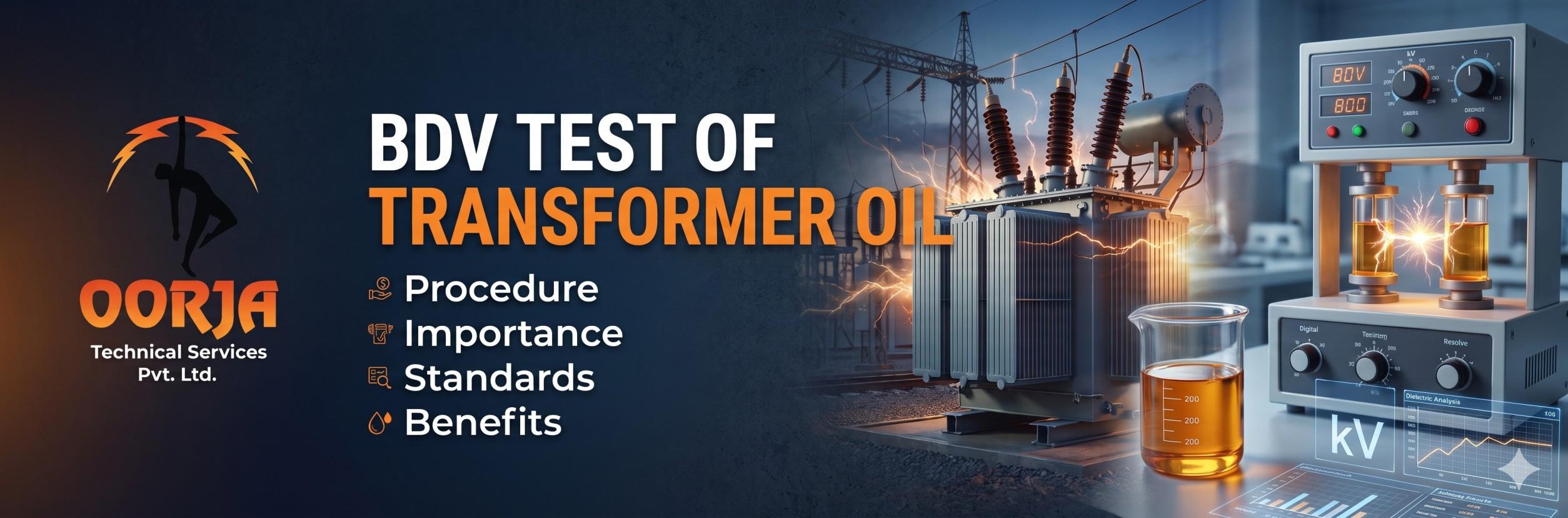
BDV Test of Transformer Oil: Procedure, Importance, Standards and Benefits

Transformers depend on insulating oil to provide electrical insulation and assist in heat dissipation. Maintaining the oil's dielectric properties is essential for reliable transformer operation.
The BDV test of transformer oil is a commonly used electrical test that evaluates the oil's ability to withstand voltage under specified laboratory conditions. The broader dissolved gas analysis of transformer oil can complement this assessment.
BDV stands for Breakdown Voltage. During testing, voltage is increased across two electrodes immersed in an oil sample until electrical breakdown occurs, according to the applicable test method.
The test result provides useful information about the dielectric strength of the oil and can help identify potential contamination or moisture-related issues.
What Is the BDV Test of Transformer Oil?
The BDV test measures the voltage at which an insulating oil sample breaks down electrically under defined test conditions. The result is generally expressed in kilovolts (kV).
A low breakdown voltage may be associated with moisture, particles or other contamination. However, BDV results alone cannot establish the complete condition of transformer oil.
For a reliable assessment, BDV testing should be considered alongside other parameters, including moisture content, acidity and dissolved gas analysis, where applicable. A DGA test of transformer oil helps investigate potential internal faults.
Why Is Transformer Oil BDV Testing Important?
Transformer oil BDV testing helps maintenance teams understand the insulating performance of oil. Its major benefits include:
Evaluating Dielectric Strength — The test helps determine whether the oil meets the relevant breakdown voltage requirements under the specified test method.
Identifying Possible Contamination — Moisture and suspended contaminants can influence breakdown voltage. Testing can help identify the need for further investigation.
Supporting Preventive Maintenance — Routine testing provides information that can be compared with previous results to assess changes in oil condition.
Checking Oil After Treatment — BDV testing may be performed before and after oil filtration or dehydration to assess changes in dielectric strength.
Supporting Equipment Reliability — When combined with appropriate maintenance practices, BDV testing contributes to a broader transformer condition-monitoring programme.
How Is the BDV Oil Test Performed?
The exact procedure depends on the applicable standard and test equipment. A typical laboratory workflow includes:
Step 1: Collect the Oil Sample — Collect a representative sample using a suitable sampling procedure. Care must be taken to prevent moisture ingress and external contamination.
Step 2: Prepare the Test Cell — The test cell and electrodes are cleaned and prepared according to the applicable method.
Step 3: Fill the Test Cell — The oil sample is introduced into the test vessel while avoiding contamination and excessive air bubbles.
Step 4: Apply the Test Voltage — The voltage is increased at the specified rate until breakdown occurs.
Step 5: Record the Result — The breakdown voltage is recorded. The number of measurements, electrode arrangement and calculation procedure depend on the selected test method.
Step 6: Interpret the Results — The results are evaluated against the relevant requirements, taking account of the oil type, equipment application and test standard.
Testing should be performed by trained personnel using suitable equipment and appropriate electrical safety procedures.
What Is a BDV Tester?
A BDV tester is an instrument designed to measure the breakdown voltage of insulating liquids.
Depending on the model, a tester may provide controlled voltage application, automatic voltage increase, detection of electrical breakdown, digital result display, storage of test results and configurable testing sequences.
The suitability of a BDV tester depends on its measurement range, test-cell configuration, applicable standards and calibration status.
For dependable measurements, laboratories should use appropriately maintained equipment and follow established testing procedures.
Transformer Oil Breakdown Voltage Standards
Transformer oil BDV testing may be performed according to recognised standards, depending on the application and oil type. Two important examples are:
IEC 60156: Insulating liquids — determination of the breakdown voltage at power frequency.
IS 6792: Indian standard covering the method for determination of electric strength of insulating oils.
The current applicable edition and any customer-specific requirements should be confirmed before testing.
It is important not to compare results obtained using different test methods without considering their procedures and conditions.
Factors That Affect Transformer Oil BDV
Moisture: Water contamination can reduce dielectric strength, depending on the oil and test conditions.
Particulate Contamination: Fibres, dust and other particles may affect the electrical breakdown behaviour of the oil.
Sampling Practices: Improper containers or exposure to environmental moisture can affect the sample.
Test Cell Condition: Electrode cleanliness, electrode spacing and vessel condition can influence results.
Testing Procedure: Voltage ramp rate, sample preparation and other procedural details affect the comparability of measurements.
For this reason, consistent sampling and standardised test procedures are essential.
BDV Testing and Other Transformer Oil Tests
BDV testing is only one part of a complete transformer oil analysis programme. DGA analysis of transformer oil and furan analysis of transformer oil may provide additional diagnostic information where appropriate.
BDV test — Evaluates dielectric breakdown strength.
Moisture testing — Measures water content.
DGA testing — Helps identify potential internal thermal or electrical faults.
Acidity testing — Evaluates acidic compounds in oil.
Flash point testing — Evaluates a safety-related thermal property.
Furan analysis — Supports assessment of paper insulation ageing.
The combination of tests should be selected according to the equipment, oil condition and maintenance objectives.
Choosing a Transformer Oil Testing Laboratory
When selecting a transformer oil testing lab in India, consider whether the laboratory offers the required tests, follows appropriate standards, maintains calibrated equipment, has relevant accreditation for the specific test where required, and provides clear reports identifying the method and results.
A laboratory's accreditation should always be verified for the relevant scope. Do not assume that every test offered by a laboratory is covered by its accreditation.
Conclusion
The BDV test of transformer oil is an important diagnostic tool for assessing the dielectric strength of insulating oil. It helps identify possible contamination and supports routine maintenance decisions.
However, BDV results should be interpreted alongside other oil tests and transformer operating information to develop a more complete understanding of equipment condition.
Oorja Technical Services Pvt. Ltd. provides technical services for organisations requiring electrical testing and calibration support. For enquiries about BDV testing, transformer oil analysis or related testing requirements, contact the team.
Contact Oorja Technical Services Pvt. Ltd.
Website: oorjatechnical.in
Email: [email protected]
Phone: +91-9907759797