
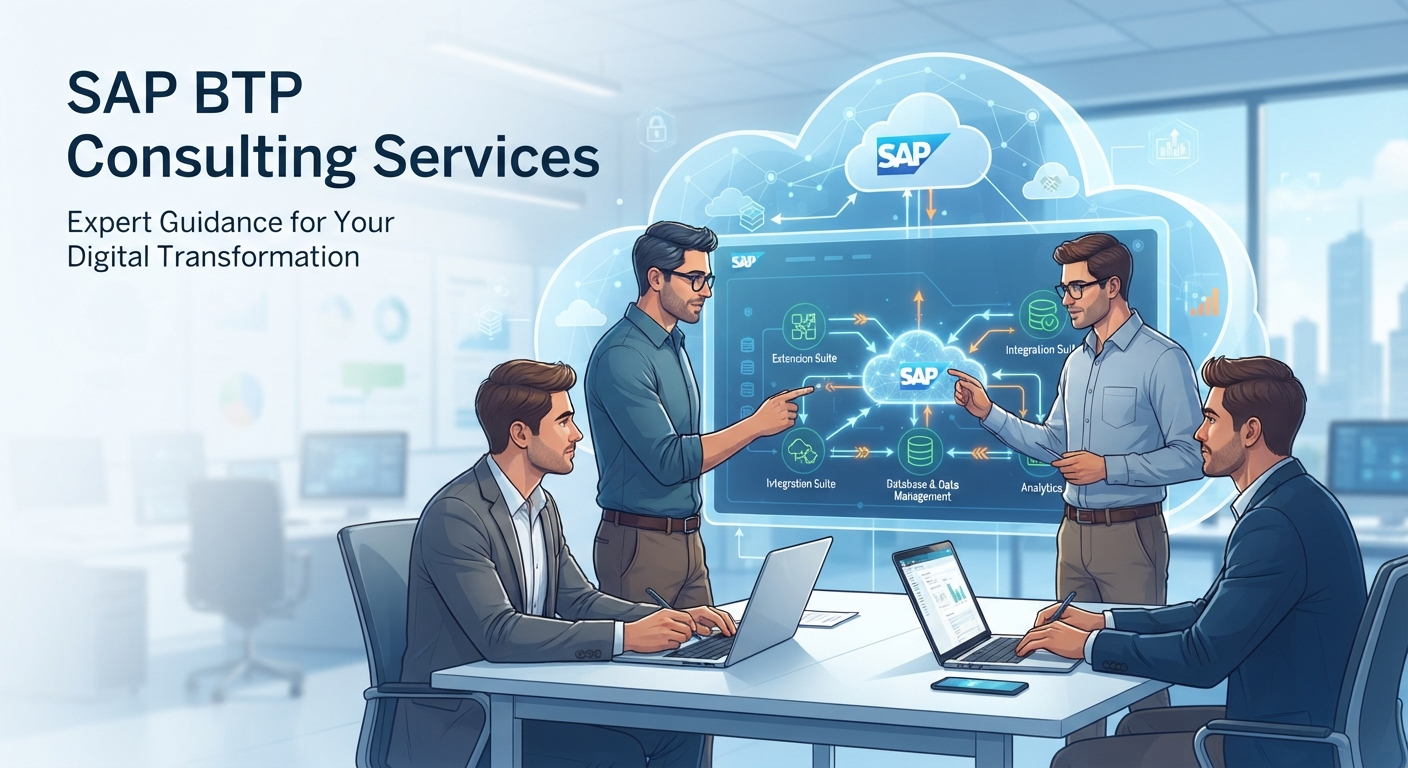
Beyond Implementation: Why Enterprises Are Rethinking Cloud Strategy Through SAP BTP Consulting Services
Enterprises today are no longer asking whether to move to the cloud — they're asking how to connect everything that already lives there. Legacy ERP systems, third-party SaaS platforms, IoT devices, and modern microservices all need to talk to one another in real time. This is exactly where SAP BTP Consulting Services step in, helping organizations design, build, and manage a unified digital core that doesn't just migrate data but transforms how business processes actually run.
SAP Business Technology Platform (BTP) has emerged as the backbone of intelligent enterprises, combining database management, analytics, application development, automation, and integration into a single platform. But owning the platform isn't the same as mastering it. That gap between potential and performance is why demand for experienced partners offering specialize SAP BTP Consulting Services continues to rise across industries like manufacturing, retail, healthcare, and financial services.
The Shift From Point-to-Point Integration to Intelligent Connectivity
For years, businesses relied on point-to-point integrations — custom scripts and middleware stitched together to move data between SAP ECC, S/4HANA, Salesforce, Workday, or on-premise legacy systems. This approach worked until it didn't. As the number of applications grew, so did the complexity, technical debt, and failure points.
SAP BTP Integration Suite was built to solve exactly this problem. It functions as a hybrid integration platform (iPaaS) that supports cloud-to-cloud, cloud-to-on-premise, and B2B/B2G integration scenarios through a single, governed environment. Concepts like integration flows, prebuilt content packages, API Business Hub connectors, Open Connectors, and event-driven architecture are not just technical buzzwords — they represent a fundamentally different way of thinking about enterprise connectivity.
This is precisely why organizations partner with firms specializing in SAP BTP Consulting Services: to translate these capabilities into a working, scalable integration landscape rather than a patchwork of workarounds.
What Makes SAP BTP Integration Suite the Core of Modern Connectivity
To understand the real value consultants bring, it helps to look at what SAP BTP Integration Suite actually does under the hood.
Cloud Integration capabilities allow businesses to design integration flows using a graphical, low-code interface, reducing the need for heavy custom development. Instead of writing thousands of lines of code to synchronize sales orders between S/4HANA and a CRM, teams can configure prebuilt adapters and content packages that SAP maintains and updates.
API Management is another core pillar. As companies expose internal services as APIs — whether for partners, mobile apps, or internal microservices — they need governance, security, throttling, and analytics. SAP BTP Integration Suite's API Management capability acts as a gateway that protects backend systems while making services easily discoverable and reusable.
Then there's Event Mesh, which enables event-driven architecture — a critical capability for real-time use cases like inventory updates, order status changes, or IoT sensor triggers. Instead of systems constantly polling each other for updates, applications can publish and subscribe to events, dramatically reducing latency and system load.
Open Connectors extend this ecosystem further by providing pre-built connectivity to hundreds of non-SAP, third-party, and cloud applications — think Salesforce, ServiceNow, Shopify, or Marketo — without needing to build custom APIs from scratch.
B2B/B2G Integration capabilities handle complex trading partner communication, EDI formats, and government reporting requirements, which are especially critical for manufacturing, logistics, and public sector organizations.
Each of these components is powerful individually, but the real transformation happens when they're architected together as part of a coherent integration strategy — and that architectural thinking is the heart of good SAP BTP Consulting Services.
Why Businesses Struggle Without the Right Consulting Partner
Many organizations purchase SAP BTP licenses with ambitious plans, only to find themselves overwhelmed by the platform's breadth. BTP isn't a single tool — it's an ecosystem that includes SAP HANA Cloud, SAP Build (for low-code/no-code app development), SAP Integration Suite, SAP Analytics Cloud, and SAP AI Core, among others.
Without proper governance, companies often end up with:
- Redundant integration flows built by different teams solving the same problem differently
- Inconsistent API naming conventions and security policies across departments
- Poor visibility into data lineage and integration performance
- Underutilized automation capabilities that could reduce manual effort
- Integration sprawl that increases maintenance costs over time
This is the operational chaos that experienced SAP BTP Consulting Services providers are brought in to prevent or fix. A skilled consulting partner doesn't just configure integration flows — they establish integration governance frameworks, naming standards, monitoring dashboards, and reusable templates that scale with the business rather than against it.
The Strategic Role of Consulting in Integration Suite Adoption
A mature consulting engagement typically moves through several phases, each demanding a different kind of expertise.
Discovery and Landscape Assessment
Before any integration flow is built, consultants map the existing application landscape — identifying which systems need to talk to each other, what data formats are involved, and where bottlenecks currently exist. This phase often reveals shadow IT integrations that nobody officially documented, which, if ignored, can derail a BTP rollout.
Architecture and Design
This is where decisions are made about whether to use Cloud Integration, API Management, Event Mesh, or a combination of all three. Consultants also decide on hybrid connectivity patterns — for example, using SAP Cloud Connector to securely bridge on-premise SAP systems with cloud-based integration flows without opening unnecessary firewall ports.
Build and Configuration
Here, integration flows, API proxies, and message mappings are actually built. Experienced consultants lean heavily on prebuilt content from the SAP API Business Hub, customizing only where business-specific logic demands it. This reduces development time significantly compared to building everything from scratch.
Testing and Performance Tuning
Integration scenarios are tested not just for functional correctness but for throughput, latency, and failure handling. This includes setting up retry mechanisms, dead-letter queues, and alerting for failed message processing — details that are easy to overlook but critical in production environments.
Monitoring, Governance, and Continuous Optimization
Post go-live, the work isn't over. Integration landscapes evolve as businesses add new applications or retire old ones. Ongoing SAP BTP Consulting Services engagements often include monitoring dashboards, SLA tracking, and periodic architecture reviews to ensure the integration layer keeps pace with business change.
Industry-Specific Use Cases Where Integration Suite Delivers Value
Manufacturing
Real-time production data from shop-floor systems can be integrated with S/4HANA using event-driven patterns, enabling predictive maintenance and reducing unplanned downtime. B2B integration capabilities also streamline EDI-based communication with suppliers and logistics partners.
Retail and E-commerce
Order management, inventory synchronization, and customer data integration between e-commerce platforms, POS systems, and SAP Commerce Cloud rely heavily on API Management and prebuilt connectors to maintain a consistent customer experience across channels.
Healthcare and Life Sciences
Integration Suite helps synchronize patient records, supply chain data, and regulatory reporting systems while maintaining compliance with data privacy standards — a use case where secure API gateways and encrypted data flows are non-negotiable.
Financial Services
Real-time fraud detection and transaction monitoring often depend on event-driven architecture, where Event Mesh enables instant communication between core banking systems and risk management platforms.
In every one of these scenarios, the technical capability of SAP BTP Integration Suite is only half the equation. The other half is designed and delivered through experienced SAP BTP Consulting Services, ensuring the technology aligns with actual business outcomes rather than existing as an underused feature set.
Common Mistakes Businesses Make Without Expert Guidance
Even technically capable IT teams can stumble when adopting BTP Integration Suite without structured guidance. Some frequent missteps include:
- Treating integration as a one-time project rather than an ongoing capability that needs governance.
- Over-customizing prebuilt content packages instead of adapting business processes to standard flows where possible.
- Ignoring API lifecycle management, leading to deprecated APIs still being consumed by critical applications.
- Underestimating the importance of monitoring and alerting until a production outage forces reactive fixes.
- Failing to document integration flows, creating knowledge silos when original developers move on.
A seasoned consulting partner helps organizations avoid these pitfalls by bringing cross-industry experience and proven implementation frameworks rather than learning through costly trial and error.
Choosing the Right SAP BTP Consulting Partner
Not all consulting engagements are created equal. When evaluating a partner for SAP BTP Consulting Services, businesses should look beyond certifications and consider:
- Demonstrated experience with Cloud Integration, API Management, and Event Mesh in production environments
- A track record of hybrid integration projects connecting on-premise and cloud systems
- Clear governance frameworks for API security, versioning, and monitoring
- Knowledge transfer practices that avoid vendor lock-in
- Flexibility to support both greenfield implementations and brownfield system migrations
The right partner doesn't just "implement" BTP — they help build institutional knowledge so that internal teams can eventually manage and extend the platform independently.
The Future of Integration: Where BTP Is Headed
SAP continues to invest heavily in making Integration Suite more intelligent, incorporating AI-assisted mapping suggestions, predictive monitoring, and deeper automation through SAP Build Process Automation. As enterprises increasingly adopt composable architecture — assembling best-of-breed applications rather than relying on a single monolithic system — the role of a robust integration layer becomes even more critical.
This trend reinforces why forward-thinking organizations continue investing in SAP BTP Consulting Services: integration is no longer a background IT function, but a strategic enabler of digital transformation, operational resilience, and customer experience.
Conclusion
SAP BTP Integration Suite offers enterprises a powerful, flexible foundation for connecting applications, automating processes, and enabling real-time data flow across hybrid landscapes. But technology alone doesn't guarantee transformation — it requires thoughtful architecture, disciplined governance, and continuous optimization. That's the value that experienced SAP BTP Consulting Services bring to the table: turning a feature-rich platform into a genuinely strategic asset.
Organizations that invest in the right consulting expertise don't just solve today's integration challenges — they build a scalable, future-ready foundation capable of absorbing new applications, emerging technologies, and evolving business models for years to come.